Your browser version is outdated. We recommend that you update your browser to the latest version.

FAMILY STRUCTURE 


The Métis family structure has always been the backbone of Métis communities and has provided the foundational relationship for economic, political, social and cultural activities and alliances. 

The family provides a sense of belonging and supports the well-being of each individual. The concept of wahkohtowin (wa-ko-to-win), a Cree word that expresses the interconnectivity and relationships we share with all things, is central to the Métis understanding of the social responsibilities and obligations held between members of the family and community. 

Many components of Métis culture-such as beading, dances, music and weaving-are linked to family traditions. When Métis people were dispersed from their homeland and lived outside of Métis communities, the family continued to be the primary vehicle for passing on cultural knowledge and ways of being.

The Métis have an extended multi-generational family structure known as kinship networks. Kinship networks are one of the most significant factors in structuring Métis communities. Extended family members often have roles in raising children, who grows surrounded by networks of aunts, uncles, cousins and grandparents. Métis people often take pride in tracing their roots back multiple generations to the Red River era or before, and in doing so finding connections within the larger Métis Nation.

Metis Culture Demonstrates high respect for women and Elders. Women have always had influential and distinct roles in Métis society and are seen as keepers of the land, law, kinship knowledge and culture. They also traditionally held a respected role in raising children alongside other family members, notably grandparents. Elders are honored as advisors and Knowledge Keepers, and in Métis communities they are often responsible for making leadership decisions or resolving conflicts. They also play an essential role in passing down language and culture to the younger generations.


Reference: KAA-WIICHIHITOYAAHK Metis Perspective Cultural Wellness Book P. 65

ART AND CLOTHING 


BEADWORK 

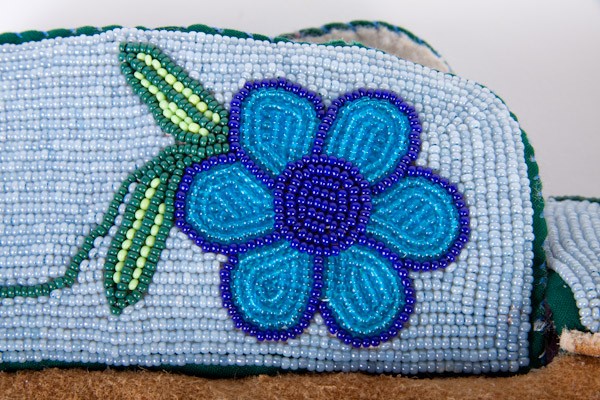
The Flower Beadwork People

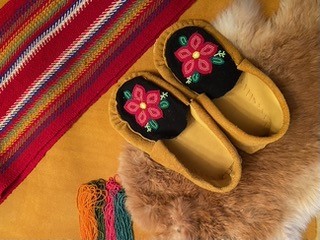
Women were an essential part of the success of the Métis as they kept close ties to their First Nations families and brought with them the skills for making food, tanning hides, and making clothing. Beading was originally done in geometric patterns by several of the Plains First Nations. Métis girls were taught embroidery with floral designs by the Grey Nuns and from these patterns, Métis women created a distinct form of beadwork that involved organic forms and floral motifs. They incorporated so much colour and decoration into their clothing that it became an art form. From this, the Métis became known as ‘the flower beadwork people’. Their beadwork decorated coats, mittens, leggings, pouches, saddle pads and blankets. It’s an incredibly beautiful art that became very fashionable in Europe at the end of the 19th century. With the demise of the bison, this art form became an important source of income for the Métis. The irony is that Europeans often wanted their artwork to come from “real native” artists, so the Métis often sold their art to other First Nations groups, who then resold them to the European traders.


 References:

Laura Peers, "Many Tender Ties: The Shifting Contexts and Meanings of the S BlackBag", World Archeology, Vol. 31 (2), 1999, p. 288.

 Patrick Young, MétisBeadwork, Quillwork and Embroidery, Gabriel Dumont Institute, 2003


SASH

The Métis is probably the most distinctive article of clothing and is considered by many Métis to be a visible symbol of their identity. It was originally known as une ceinture fléchée, meaning "arrow belt" because of the zig-zag pattern. They were created from European wool, using a First Nations finger weaving technique that is still often used today. Each handwoven sash takes hundreds of hours to create.


The sash is typically worn wrapped around the waist for men or over the shoulder for women. Today the sash is often worn as ceremonial dress to honour people for achievements and recognize membership in a Métis community. Wearing the sash connects Métis people with their ancestors and their Métis identity. 


Reference: KAA-WIICHIHITOYAAHK Metis Perspective Cultural Wellness Book P. 70

Uses of the Sash

The sash was not just a decorative item. It was used for many practical purposes, such as the following:

  • Holding the coat closed or the pants up
  • Muffler or scarf
  • Sling, bandage or tourniquet
  • Washcloth
  • Bridle/Saddle Blanket
  • Trail marker or sewing kit (by removing the threads at the end of the sash)
  • Pocket
  • Back support when holding heavy objects
  • A rope (useful to portage canoes)
  • Identifying one's skill in a buffalo hunt
  • As a calendar system (threads were used to mark days on the trapline)

CAPOTE

Resilience: Métis Material Culture

The goal of the workshop is to reclaim a unique garment, affectionately known among the Métis as the Capote. It was created by our First Nations grandmothers, married to our fur trader grandfathers, who wanted to make European styled coats inspired by the European great coat for their husbands. The formula used to fit the Capote for individuals was originally adapted from the formula they used to make their hide dresses. When hides became scarce they made them from Hudson’s Bay blankets, and it became the Hudson’s Bay Blanket Coat. Now we can apply that same formula to fleece capotes. As a symbol of our Métis Nation’s resilience we will make it our own again by using fleece material or fleece blankets to make our capotes. The capotes will then become a garment that links us to our past but in the way of the Métis, it will be updated and current, a modern expression of the pragmatic and resilient nature of the Métis.

The workshop is a great way to build community. It's meant for a small group, 10 people at most, to be shared over 3 days. That could be a long weekend or 1 day over 3 weekends. During the workshops there will be presentations given about our Métis origin story, values and material culture. This has proven to be beneficial for family participation and team building.

If you are interested please contact Kokum Deni at 778-350-9663 or denipaquette@hotmail.com 
 
Thank you so much for your interest in “Métis Arts as an Act of Resilience"
 

MOCCASIN


The Moccasins kept feet warm and dry in all kinds of weather conditions and were acknowledged by fur trades to be the best footwear for travelling through the backcountry.

DANCE AND MUSIC


Dance and music are integral parts of Métis culture. Traditionally, music permeated daily life in Métis communities, and today there is unlikely to be a Métis cultural gathering without music. Métis music is influenced by folk fiddling from Ireland, Great Britain and France, and by the structure of First Nation's music. Music can also be unique to families, who may have their own styles, tunes, songs and dances.

Métis are best known for their fiddle music. Fiddles were expensive to purchase during the fur trade era and were therefore handmade from local wood such as maple and birch, Métis music accompanies traditional dances such as Métis jigging, a lively dance with fancy footwork influenced by Scottish highland dancing, as well as by First Nations and Celtic dancing. 

Métis dance involves the audience clapping, cheering and playing the spoons to accompany the music. All ages are encouraged to engage in dance, with Elders chair-jigging if preferred, as dance is a way of connecting a community and celebrating Métis roots. The Red River Jig is the best-known Métis dance.


Reference: KAA-WIICHIHITOYAAHK Metis Perspective Cultural Wellness Book P. 72


LANGUAGE


Michif is a distinct Métis language and has a unique mixed-language structure. This language is endangered, and Métis today are working to revitalize and protect it.


Reference: KAA-WIICHIHITOYAAHK Metis Perspective Cultural Wellness Book P. 74